HistoriaSzkod.pl
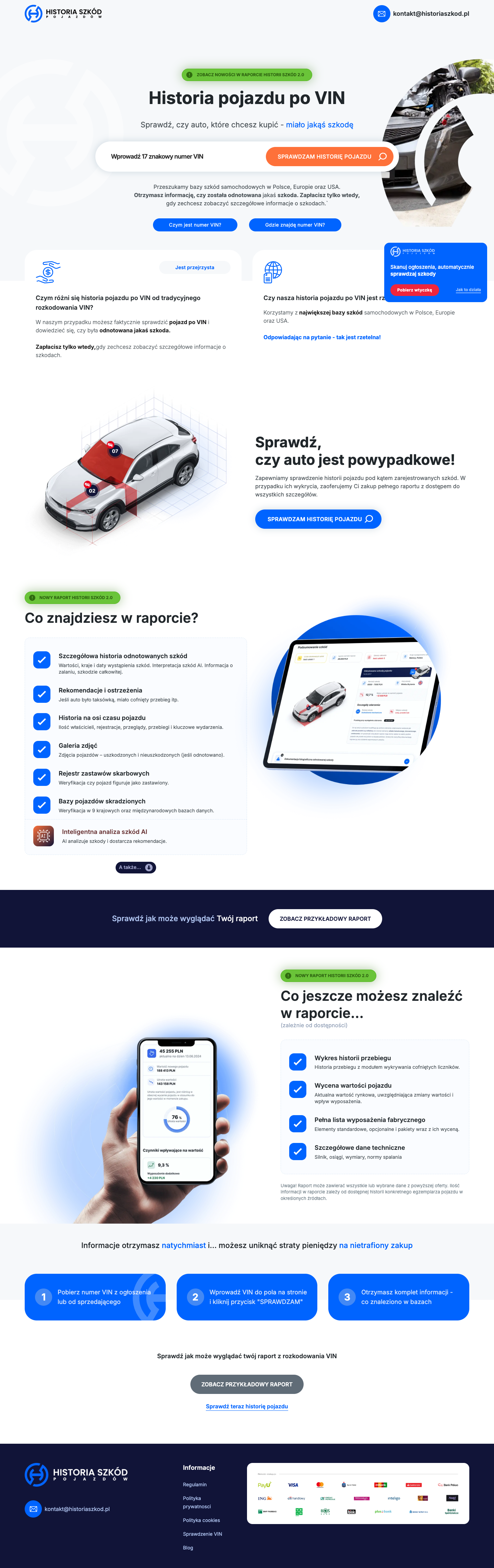
Platform and API for verifying vehicle damage history by VIN number — with a comprehensive report, instant access after purchase, and a high-performance backend handling hundreds of concurrent requests.
 Next.js
 React
NodeJS
REST API
React
NodeJS
REST API
 AWS
API Integrations
PayU
Monitoring
AI
AWS
API Integrations
PayU
Monitoring
AIWhat challenges did we solve?
The goal of the project was to build a platform and public API that combine a simple VIN form, a clear report, and a smooth checkout into a single funnel — while maintaining performance even under heavy traffic.
Consistency across the entire user journey
The user must move smoothly from entering the VIN number to a purchase decision without losing context or understanding of the report's value.
Clear VIN entry point
The homepage was designed around a single goal: quickly starting vehicle verification by VIN number.
Rich data sources
The report contains many modules — damage, timeline, warnings, legal status, valuation, and photo gallery — all of which need to be understandable at a glance.
Modular Report 2.0 structure
The report is divided into logical sections with a contextual menu, making it easy to navigate large amounts of data and quickly find key information.
Conversion in the purchase flow
The purchase view needed to clearly communicate the report's contents, price, and formal steps, minimising cart abandonment.
Recommendations and warnings layer
Suggestion mechanisms and damage interpretation were implemented to help users assess the risk of purchasing a vehicle.
Product evolution without quality loss
The platform was developed in phases, so maintaining a consistent UX while adding new sections and features was critical.
Decision-oriented checkout
The purchase view presents report benefits and payment conditions on a single screen, simplifying order finalisation.
API performance under heavy traffic
The API must handle hundreds of concurrent requests — querying multiple external data sources simultaneously — without response time degradation.
High-performance API
Backend optimised for concurrent querying of multiple data sources, leveraging AWS. The API returns a complete report within seconds, regardless of load.
Data complexity
The system generates reports by analysing multiple external sources, which increases processing complexity and the volume of generated logs.
Monitoring and metrics
We implemented monitoring of API touchpoints and critical system nodes. The client gained full visibility into performance, data quality, and business metrics for planning next steps.
translationKey: “historiaszkod”
About the project
HistoriaSzkod.pl is a SaaS platform and public API for verifying vehicle damage history by VIN number. The user enters a number, receives a comprehensive report — with a damage timeline, warnings, legal status, valuation, and photo gallery — and finalises the purchase in one seamless process.
The project was carried out in collaboration with Datazen. The key challenge was connecting three stages — VIN verification, report analysis, purchase — into a single journey, while maintaining API performance handling hundreds of concurrent requests from multiple external data sources.
How we solved the performance problem
We built the backend on Node.js with AWS infrastructure and Docker containerisation. The API queries multiple external data sources simultaneously and returns a complete report within seconds — regardless of load. We implemented monitoring of critical system nodes, giving the client full visibility into performance, data quality, and business metrics.
Report 2.0 was divided into logical sections with a contextual menu — damage, timeline, warnings, legal status, valuation, gallery. The checkout is decision-oriented — report benefits and payment conditions on a single screen.
The platform is the foundation for the Historia Szkód browser plugin, which detects VIN numbers on listing pages and enables instant verification with a single click.
How did the delivery process look?
User journey design
We mapped the full flow from the VIN form to payment, defining critical decision moments and points requiring maximum clarity.
External system handling
We designed the report structure based on sections generated from data analysis across multiple sources.
Optimisation
We optimised the API and AWS infrastructure so report delivery time is minimal even under heavy load — with no compromise on data quality.


A product that guides users to a decision
Seamless flow from VIN check to report purchase in a single user experience.
Iterative product development and rapid deployment of additional report modules.
Platform UX/UI, frontend layer, high-performance API, AWS infrastructure, report presentation, and VIN report checkout.
The user goes through the entire process in one coherent experience.
The new report version organises data and increases its usability.
REST API handling hundreds of concurrent requests with response times measured in seconds — ready for integration by partners.
Containerised system on cloud infrastructure, ready for traffic growth without manual intervention.
HistoriaSzkod.pl is a platform and public API that combine a simple VIN form, a comprehensive report, and a fast checkout — with a high-performance backend handling traffic without quality degradation.
Other case studies
All
IT System Modernisation
IT modernisation for an automotive company — 90% faster system loading and 50% lower infrastructure costs.

Historia Szkód - Browser Plugin
Chrome/Firefox extension that detects VIN numbers on listing pages and verifies damage history with a single click.

Krakowska Szkoła Restauratorów
Website with online enrolment system for a barista school — from 8 hours of administrative handling to a few minutes.
Building a data-driven product with reports?
We design and develop platforms that connect complex data with simple user decisions.
Let's talk about your project