HR Event Management System
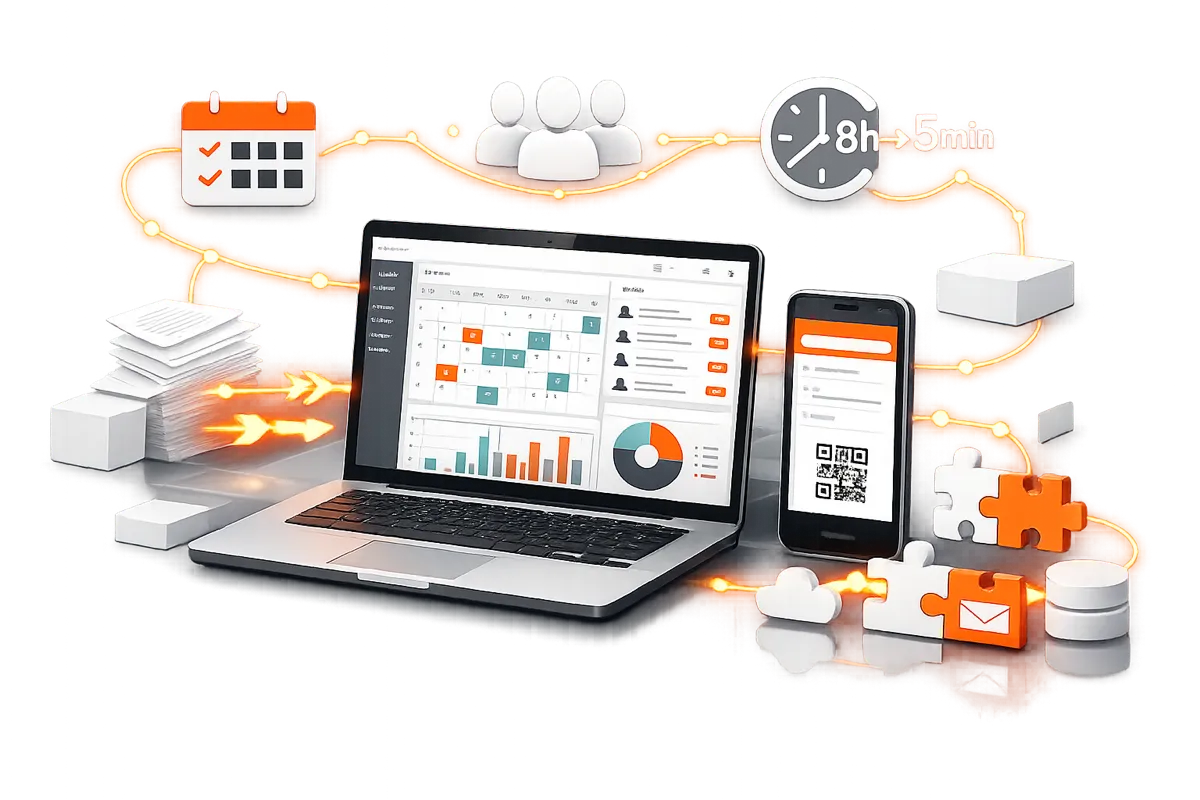
Event process automation for an HR company specialising in building IT teams. From 8 hours of manual work to a few minutes.
 Vue.js
 Node.js
 Fastify
 PostgreSQL
API Integration
Mobile-First
PostgreSQL
API Integration
Mobile-FirstWhat challenges did we solve?
An HR company organising ~8 events per month was spending over 6 hours on manual handling of each one.
Time-consuming event handling
Preparing each event required over 6 hours of manual work
Event management panel
An intuitive system enabling event creation and management in a few minutes.
Manual data copying
Data from spreadsheets had to be manually transcribed into the system
Mobile registration
Dedicated URLs enabling quick participant registration via smartphone.
Duplicate problem
The lack of automatic participant duplicate detection required time-consuming manual checking
Full automation
Automatic registration processing, summary generation, statistics.
Paper-based processes
On-site registration was done on paper forms
Integration with existing tools
Seamless integration with systems already used by the client.
translationKey: “system-zarzadzania-eventami-hr”
About the project
An HR company specialising in building IT teams was organising around 8 recruitment events per month — tech meetups, competency workshops, open days for developers, and speed-recruiting sessions. Each event gathered from a dozen to over a hundred participants, and the scale was growing quarter by quarter.
Preparing a single event required over 6 hours of manual work. The coordinator had to manually create forms in spreadsheets, copy participant data between tools, check for duplicates against lists from previous events, and print paper attendance sheets. With 8 events per month, this meant over 48 hours of pure administrative work — time the HR team could have spent on candidate and client relationships.
How we solved it
We built a custom event management system based on Vue.js (frontend), Fastify (backend), and PostgreSQL (database). The technology stack choice wasn’t arbitrary: Vue.js provides a fast, responsive admin panel interface, Fastify handles real-time registrations with minimal server load, and PostgreSQL with native JSON support allows flexible storage of variable event data without rigid schemas.
The central element of the system is mobile registration. Each event receives a unique URL that the coordinator shares with participants. The form is responsive — optimised for smartphones, because most registrations happen on a phone. After filling in the form, the participant receives an instant confirmation, and the data goes directly to the panel without manual transcription.
The key function is automatic duplicate detection. The system applies fuzzy matching across three fields — email address, phone number, and full name. If someone registers with a different email but the same phone number and a similar spelling of their surname, the system flags the entry as a potential duplicate for verification. This eliminates a problem that previously required manual comparison of lists from dozens of events.
Everything was integrated with the tools the company already used — without needing to change existing participant communication processes.
From 8 hours to 5 minutes
This isn’t a tagline — it’s a real change measured after the first month of deployment. Here’s how individual processes were transformed:
- Event creation: previously a spreadsheet copied and edited manually, now a template with configurable fields — ready in a few clicks.
- Participant registration: previously paper forms and manual data entry, now a mobile form with instant database saving.
- Reporting: previously manual aggregation of data from multiple spreadsheets, now an automatic dashboard with attendance figures, statistics, and participant history.
- Duplicate handling: previously manual comparison of lists from dozens of events, now automatic detection at the point of registration.
The HR team recovered dozens of hours per month. Registration available 24/7, zero duplicates in the system, full digitisation of paperwork.
Business impact for the HR company
Time savings are just the first dimension of the change. Digitising event processes opened up three concrete business opportunities for the company.
First — scalability. With manual handling, increasing the number of events required proportionally more people. Now the company can organise 12 or 15 events per month without additional burden on the coordination team.
Second — candidate experience. Registration via smartphone with instant confirmation is the standard IT-sector candidates expect. No paper lists and smooth on-site handling build the image of a professional organisation.
Third — data-driven decisions. A panel with attendance history and participation statistics allows evaluation of the effectiveness of individual event formats. The company knows which types of meetings attract the best candidates and can consciously allocate the events budget.
This is an example of a custom system built for a specific process of a single organisation — with a measurable result from the first month.
How did the delivery process look?
Process and requirements analysis
We began with a detailed analysis of current event organisation processes, identifying key pain points and automation opportunities.
Management system design
We designed an intuitive panel for event management and a mobile registration system available 24/7.
Implementation and integration
We deployed the system with full integration with the client's existing tools and automatic duplicate detection.
More efficient HR event organisation
Reduction of event handling time from 6 hours to a few minutes.
Visible time savings from the first implemented processes.
Process analysis, event panel, mobile registration, automations, and tool integrations.
From 8+ hours of manual work to a few minutes thanks to process automation
Participants can register at a convenient time
Automatic detection and elimination of duplicate registrations
The HR client gained a tool that allows an event to be prepared in a few minutes instead of several hours — with full registration and reporting automation.
Other case studies
All
IT System Modernisation
IT modernisation for an automotive company — 90% faster system loading and 50% lower infrastructure costs.

HistoriaSzkod.pl - VIN Report Platform
Platform and API for verifying vehicle damage history by VIN — with a high-performance backend, a clear report, and fast online purchase.

Historia Szkód - Browser Plugin
Chrome/Firefox extension that detects VIN numbers on listing pages and verifies damage history with a single click.
Need a similar solution?
If your team is losing time on repetitive processes, we'd be happy to talk about what can be improved.
Free consultation