Skip to content
24/7 Stability

Support & Maintenance

System maintenance with clear accountability. We monitor, respond to incidents, deploy updates, and develop solutions so they operate reliably every day.
24/7 monitoring and alerting
SLA agreed response times
1 point of contact
The challenge

When does a system need permanent technical support?

System instability, delayed incident responses, and no partner taking responsibility for environment performance after deployment.

IT system support and maintenance is ongoing responsibility for the stability, security, and development of software after deployment. Hexacode fulfils this role as a permanent technical partner - the same experienced team that knows the system architecture, monitors it 24/7, and responds to incidents within agreed SLA times.

When does a system need a permanent technical partner?

Technical support makes sense when system downtime genuinely costs - time, money, or client trust. If your system handles orders, internal processes, or client communications and you don’t have a team that can respond to incidents within hours - you need a partner who takes responsibility for that.

It’s not about a helpdesk. It’s about a permanent team that knows your system, monitors it 24/7, and responds according to agreed priorities before small signals become larger incidents.

How we organise support

We start with a technical audit - we assess the state of the system, document the architecture, and identify risks. Based on this, we agree on the support model: request priorities, SLA response times, and the scope of preventive work. Every priority has an assigned concrete response time, agreed at the start of the collaboration.

We also take over systems we didn’t build. This is one of our most common scenarios - a company has a system from a previous contractor, no documentation, and unclear architecture. We gradually take over responsibility, document knowledge, and stabilise the environment.

What exactly do we monitor?

24/7 monitoring is not a single ping every minute. It’s a set of metrics that give a complete picture of system health and allow problems to be detected before they become outages.

Uptime and availability - we check that the system responds with the expected HTTP code and within acceptable time. If an endpoint stops responding or the response time exceeds an agreed threshold, an alert reaches the team within seconds.

Response times - we monitor the latency of key endpoints (API, frontend, database queries). A 20–30% performance degradation can be invisible to users but signals a problem that will turn into an outage within days. We respond to the trend, not the incident.

Error rate - we track the proportion of error responses (5xx, timeouts, exceptions) in real time. A sudden spike from 0.1% to 2% means something changed - a new version, a change in an external API, resource exhaustion. We analyse the root cause instead of waiting for a user report.

SSL certificates and domains - we monitor certificate and domain expiry dates 30 days in advance. An expired certificate isn’t just a lack of encryption - it’s a browser warning that instantly destroys client trust. This problem is entirely avoidable with proper monitoring.

Resource consumption - CPU, memory, disk, database connections. We analyse trends to plan scaling before limits are reached.

Taking over a system from another contractor

Taking over a system is one of the most common scenarios we encounter. A company has a working system but the previous contractor has disappeared, doesn’t respond in a reasonable time, or the relationship has run its course. Documentation is sparse or outdated.

Our takeover process starts with a technical audit: we analyse source code, architecture, infrastructure, external dependencies, and security status. We document what we find - not what should be there. We identify critical risks (no backups, outdated dependencies with vulnerabilities, no monitoring) and development risks (technical debt that hinders changes, no tests, hardcoded configurations).

Based on the audit, we prepare a stabilisation plan with priorities - what requires immediate attention, what can be planned for upcoming weeks, and what is a long-term housekeeping matter. The client receives a full report with recommendations and pricing for individual actions. Responsibility is transferred gradually, at an agreed pace.

Prevention instead of firefighting

Regular technical reviews, security updates, and backups are standard - not an optional extra. We recommend improvements based on real data, not guesswork.

A single point of contact for everything - the same experienced team you call with a question about a minor change and with an alert about a production outage. If your system also requires functional development, we combine maintenance with building new modules - within the same team and the same collaboration model.

How much does technical support cost?

We price individually - after auditing the system and agreeing on scope. The price depends on the complexity of the environment, the number of systems, required SLA response times, and the scope of preventive work. After an initial call, we prepare an estimate with a concrete collaboration model. We don’t lock you into long-term contracts - the notice period is 30 days.

DevOps and environment management

Beyond monitoring and incident response, we handle the infrastructure layer: environment management (production, staging, development), deployment automation, CI/CD pipeline configuration. The goal is repeatable, safe deployments - every code change goes through the same process: tests, review, staging deploy, verification, production deploy. We eliminate the situation where a deployment happens “by hand” and nobody knows exactly what was changed.

For companies that have built infrastructure ad hoc and now struggle to maintain it, we carry out migrations to organised environments with documentation and automation. This is an investment that pays off at the first incident, because system restoration time drops from hours to minutes.

Case studies

For an automotive company, we took over IT system support and reduced maintenance costs by 40% while improving performance by 80%. For Propertus - a property management firm - we’ve been the permanent technical partner for years, handling monitoring, updates, and site stability.
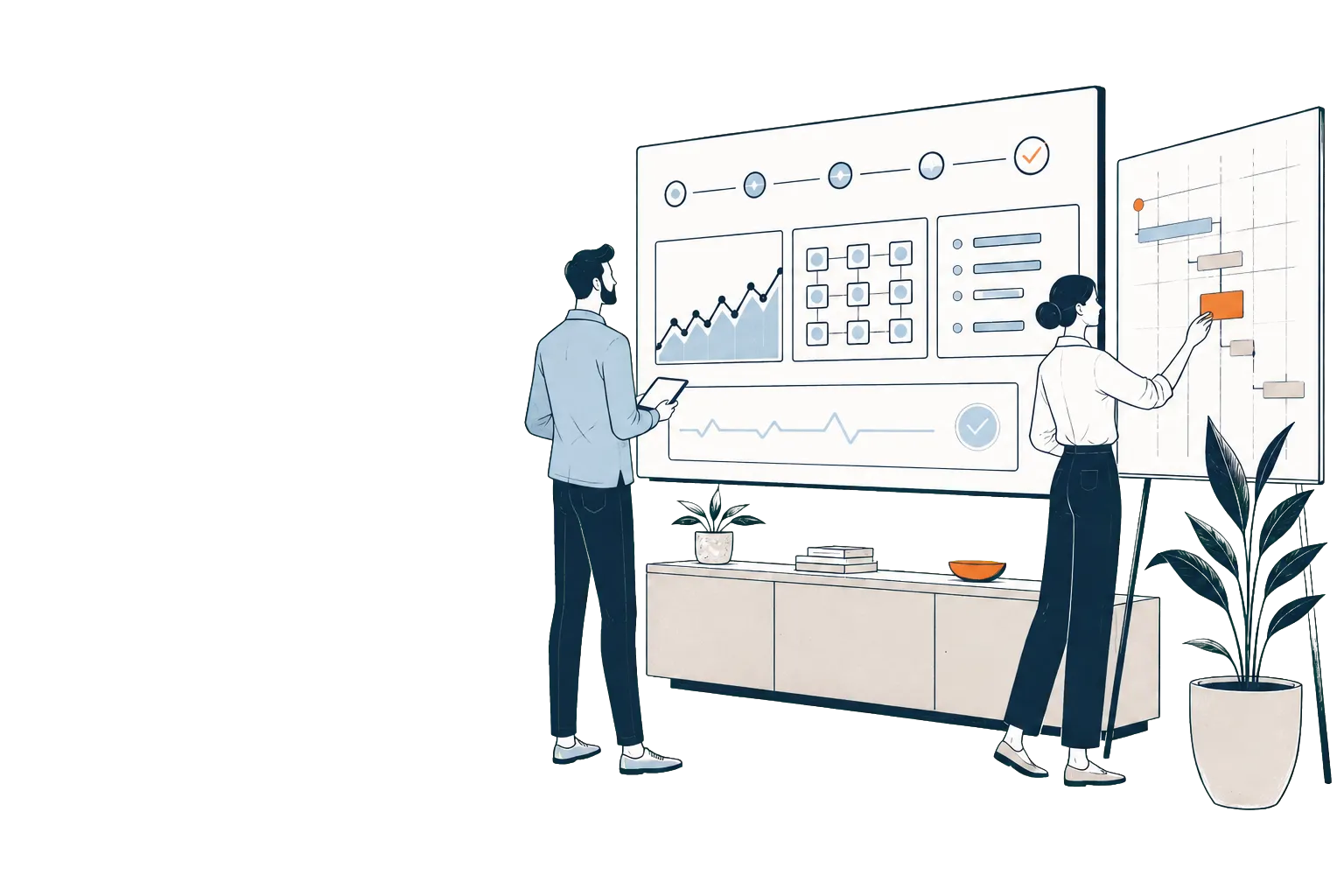
What we deliver
  • 24/7 system monitoring and alerting
  • Incident handling and agreed response times
  • Security updates and regular technical reviews
  • Performance and infrastructure cost optimisation
  • Backup, disaster recovery, and business continuity procedures
  • Functional development and product roadmap support
  • DevOps and environment management
  • System status reporting and improvement recommendations
Process

How is support and maintenance organised?

Technical review and SLA agreement

We review the system and agree on the support model, request priorities and response times. Every priority gets a written response time - not a promised one.

start of engagement

Monitoring and incident process

We configure uptime, latency, error-rate and resource monitoring, set alert thresholds and an incident handling process with escalation.

first weeks

Prevention and updates

Regular technical reviews, security updates and backups. We react to performance trends before degradation becomes an outage.

ongoing cycle

Development within the same engagement

The same team handles further functional development - no need to find a new vendor. The notice period is 30 days.

ongoing partnership
Measurable effects

What results does ongoing technical support deliver?

−40% maintenance costs after optimisation for an automotive company
20–30% performance degradation caught from trends before it becomes an outage
30 days notice period - no long-term lock-in
  • Issues detected earlier through monitoring and handled under agreed SLA
  • Clear SLA, request priorities, and a single point of contact - no guessing who's responsible
  • Your team plans product development instead of firefighting infrastructure issues
Who it's for

This makes sense if...

Book a call
  • 01 The system is critical to daily business operations and downtime or delayed responses genuinely cost time, money, or client trust.
  • 02 Your team needs a predictable partner for monitoring, incident handling, updates, and structured post-deployment development.
  • 03 You want clear accountability, request priorities, and a regular technical health picture of the system.
A different approach may be better if...
  • All that's needed is occasional firefighting, with no request process, priorities, or shared responsibility for stability.
  • The system needs to be supported as if critical, but without monitoring, backups, security procedures, or operational foundations.
  • There's no room for preventive and technical housekeeping work, and expectations are purely reactive.
FAQ

Frequently asked questions about technical support

How do we start working together?
We carry out a technical review of the system, agree on the support model, request priorities, and SLA. Based on this, we set up monitoring and the incident handling process.
Do you take over systems you didn't build?
Yes. We start with a technical audit, document the architecture, and gradually take over responsibility. This is one of our most common scenarios.
What are the response times for requests?
Response times are defined and agreed together at the start of collaboration. Every request priority has an assigned concrete response time within the SLA.
Can I use support on an hourly basis?
Yes. We offer flexible hourly packages. We bill only for hours actually worked, with full transparency.
What does ongoing technical care include?
24/7 monitoring, security updates, backups, incident response, regular technical reviews, and improvement recommendations. One point of contact for everything.

Have a question that's not listed here? Write to us - we'll give you a straight answer.

Contact

Let's talk about your project

Describe your system and what hurts today - outages, growing costs, an unresponsive previous vendor. We'll come back with a support model or a takeover plan.

Email us directly

[email protected]

Send us a short project description and we will reply within 24 hours on business days.

After first contact we schedule an initial call (30–45 min) and agree on a plan of action.

Project start within 1–3 weeks