Websites
When does your website need a fresh approach?
Inconsistent brand messaging, low form conversion, and content that doesn't answer decision-makers' questions. A good corporate website should build trust and guide users towards a specific action.
A B2B website is a sales tool that works 24/7 - it explains your offer, builds credibility, and guides visitors towards getting in touch. Hexacode designs websites and landing pages for companies where the purchase decision is multi-stage and clients need concrete arguments, not flashy animations.
When does your corporate site need a new approach?
A good corporate website isn’t a graphic design project - it’s a tool that explains your offer better than a salesperson at a first meeting. If your sales team still has to explain everything from scratch, the site isn’t doing its job.
We design websites and landing pages for B2B companies that need more than a brochure - a site that takes visitors from problem to contact, with a clear content structure and concrete arguments.
Content before design
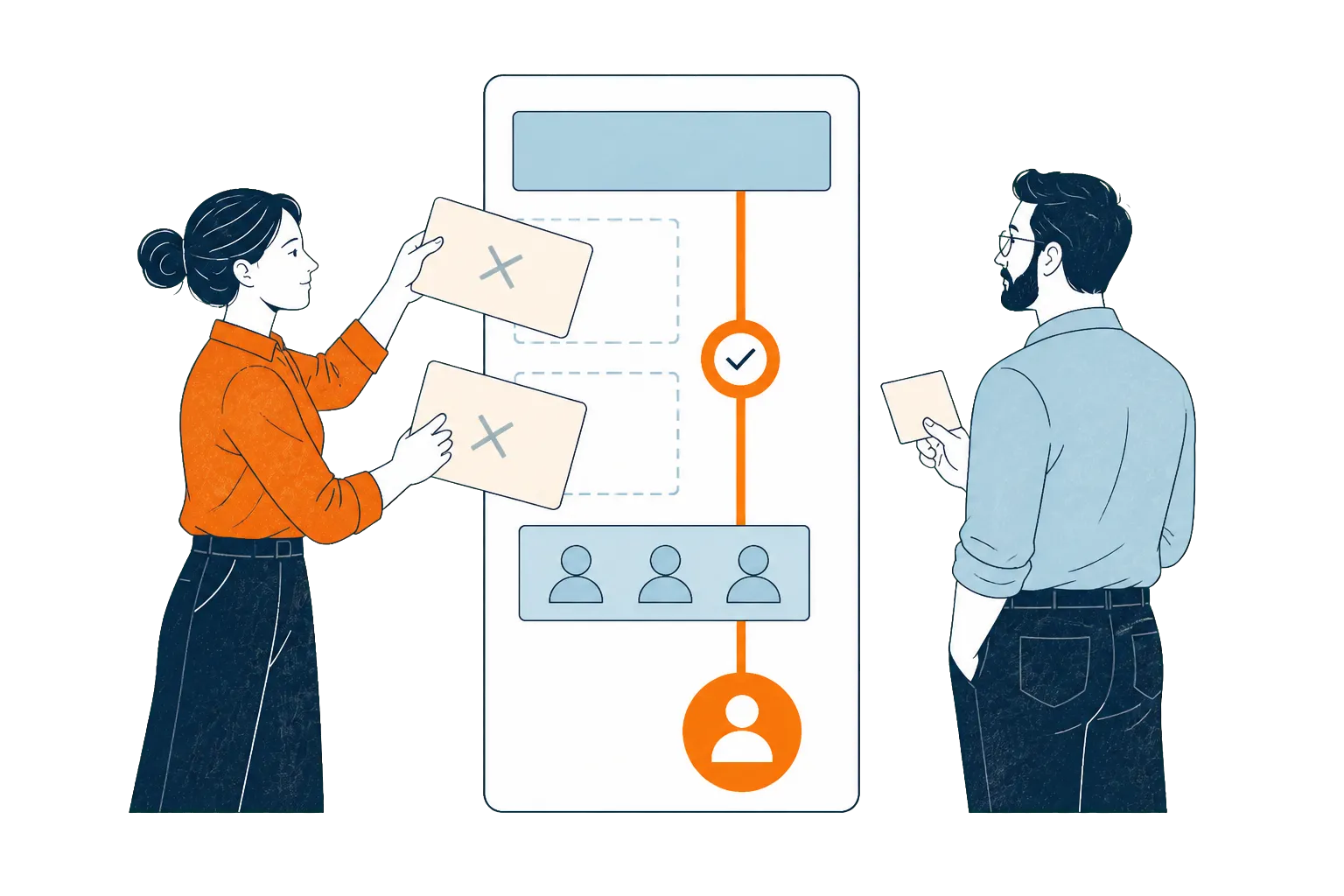
Before we start on the visual design, we work on the information architecture - what your ideal client should see and in what order. Who they are, what problem they have, why your offer solves it. Only once the content structure is approved do we design the interface that supports it.
The result? A site you can send a link to instead of a presentation. Clients arrive at meetings already oriented - they know what you do, how you work, and whether it makes sense for their situation.
The site in the buyer’s decision journey
In B2B, purchase decisions take weeks or months. Buyers compare offers, read case studies, check references, and return to the site multiple times - often from different devices. The site must support each of these stages.
At the problem recognition stage, clarity of message is key: what you do and for whom. At the comparison stage - proof of competence: case studies with concrete results, client testimonials, a description of the collaboration process. At the decision stage - easy contact: a form, a phone number, clear information about the next step.
We design site structure so that every section answers the questions relevant to that stage of the journey. It’s not a random arrangement of blocks - it’s a deliberate argumentation architecture, tested against real client sales scenarios.
Technical foundations of visibility
A site that loads slowly, isn’t responsive, or has a chaotic heading structure loses traffic regardless of content quality. That’s why technical visibility foundations aren’t an optional extra - they’re standard on every project.
Core Web Vitals - Google’s metrics for user experience (load time, layout stability, interaction responsiveness) - are optimised from day one. In practice this means: compressing and serving images in WebP format with width/height attributes to prevent layout shifts, lazy loading for elements below the fold, and minimising render-blocking CSS and JavaScript.
Heading structure (H1–H4) reflects content hierarchy, not arbitrary visual formatting. Meta tags - title and description - are written for specific queries, taking user intent into account. Schema.org (structured data in JSON-LD format) is added where it improves search visibility: Organization, LocalBusiness, FAQ, Breadcrumb.
These foundations don’t replace SEO (SEO is a separate, ongoing process), but they give the site a solid technical base to build further visibility on. Without them, even the best content faces an uphill start.
After launch - we don’t leave you
The site is a starting point, not an end product. We analyse analytics data, check which sections are working and which need adjustment. We offer post-launch support packages - so you don’t have to find someone new every time you want to make a change.
You get a CMS you can update yourself - without involving a developer every time a phone number or address changes.
Integrations that support sales
A B2B website doesn’t end with HTML. We integrate contact forms with the client’s CRM so leads go directly into the sales system without manual re-entry. We connect analytics (Google Analytics, conversion events) to measure which traffic sources generate enquiries and which just generate visits. If the company uses marketing automation tools, we integrate them so that user behaviour data on the site enriches the lead profile.
Where the sales process requires a more advanced backend - client portal, quote calculator, booking system - we design these as part of a custom system integrated with the site. The site remains the presentation layer, and business logic runs in a backend tailored to the process.
Who do we design websites for?
We most often work with B2B companies that need a site explaining a complex offer - software houses, consulting firms, manufacturers, distributors. The site needs to work for the salesperson: explain what you do, show proof of competence, and drive contact.
Performance that impacts conversion
Loading speed isn’t a technical curiosity - it has a directly measurable impact on visitor behaviour. Google research shows that every additional second of loading time increases the bounce rate by several percentage points. In B2B, where a single lead can be worth thousands of PLN, a slow site is a loss you can’t see in analytics - because the user never even reached the form.
We build sites with performance in mind from the first line of code. Static HTML generation (Hugo, Jamstack), CDN, asset optimisation and minimisation of network requests - these architectural decisions are made at the start, not as post-audit fixes. After launch we measure Core Web Vitals and optimise against agreed thresholds instead of promising universal scores upfront.
Case studies
For GrandFox we designed a site presenting their brokerage offer, in collaboration with designer Kamil Solipiwko. For ATAL Francuska Park we built a sales site for a residential development with interactive floor plans. For Krakowska Szkoła Restauratorów - an educational platform with an online enrolment system.
- Communication workshop and information architecture
- Corporate websites, landing pages, and B2B portals
- Content and structure that support conversion and search visibility
- UX/UI design and responsive implementation
- Integration of forms, CRM, analytics, and marketing tools
- Core Web Vitals performance optimisation
- CMS and content publishing workflow for the client's team
- Post-launch support and development of additional sections
What does the website design process look like?
Site goal and communication workshop
We define what the site should achieve (leads, brand image, sales support), who the audience is, and what questions they ask before deciding.
1 workshopContent structure and user journeys
We design a content architecture in which every section answers a specific buyer question and leads towards contact.
1–2 weeksUX/UI design and implementation
A responsive build with a CMS, CRM-connected forms, analytics, and technical visibility foundations (Core Web Vitals).
scope-basedPost-launch optimisation
We analyse the data and improve the sections that don't convert - the site is supposed to work, not just exist.
ongoingWhat results does a well-designed website deliver?
- Your target client understands your offer and differentiators within seconds of landing on the page
- More enquiries from people who genuinely match your ideal client profile
- Your sales team sends a link to the site instead of explaining the offer from scratch at every meeting
- 01 Your current site doesn't clearly explain what makes you different, so it doesn't support sales or business conversations.
- 02 You need a site that drives enquiries, briefs, or contact - not just something that looks good in a portfolio.
- 03 You want to combine your offer communication and brand credibility into one coherent client acquisition channel.
- — The project will be judged purely on visuals, with no business goal, communication priority, or success metric.
- — There's no readiness to refine the content, offer, and information architecture - the elements that actually influence the client's decision.
- — You expect immediate SEO results - that's a separate process we don't handle.
Frequently asked questions about websites
Can I edit content myself after launch?
Will the site be search-engine-ready?
What if I need changes after launch?
How much does a website cost?
Have a question that's not listed here? Write to us - we'll give you a straight answer.
Other services
Custom Systems
We design a solution around the way your team works. We integrate data, bring order to operations, and simplify everyday decisions.
See details Measurable pilotAI & Automation
We deploy AI agents and automations that reduce repetitive work, measure the result, and keep humans in control where decisions matter.
See details iOS + AndroidMobile Apps
We build apps for iOS and Android - from field tools to product apps integrated with company systems.
See detailsLet's talk about your project
Tell us what the site should achieve - more enquiries, a better offer presentation, or sales support. We'll get back to you with a concrete next step.
Send us a short project description and we will reply within 24 hours on business days.
After first contact we schedule an initial call (30–45 min) and agree on a plan of action.
Project start within 1–3 weeks


